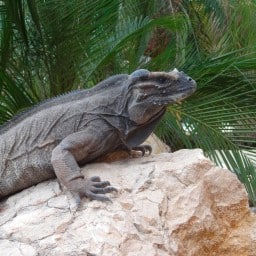
- Origin: Island of Hispaniola, Haiti, Dominican Republic
- Class: Reptiles
- Order: Squamates
- Suborder: Sauriens
- Family: Iguanidés
This Iguana is endemic to the island of Hispaniola and is particularly fond of the dry rocky land along the coast, although it can also be found inland in forests. It is robust and characterised by the presence of horned scales on the snout and sides of the head, as well as two humps on the top of the skull and a dorsal crest. Its colouring can vary: brown, grey, olive and even black. It can grow up to 1.20 m long and weigh between 6 and 10 kg. The horns, parietal humps and dorsal crest are generally more developed in males.
It is mainly terrestrial and diurnal, rather herbivorous, feeding mainly on leaves, fruit and seeds and occasionally insects, crabs or dead fish.
It breeds in spring, and about forty days later, in early summer, the female lays 2 to 34 eggs in a cavity dug in the sand. The eggs hatch around 85 days later.
Deforestation and land use are major threats to its habitat. The situation is critical on the island of Hispaniola in Haiti, where 75% of its habitat has been destroyed, and 35% in the Dominican Republic.
IUCN Status : near threatened (Appendix II)