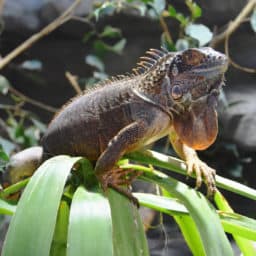
- Origin: Mexico, Paraguay, Southern Central America and Argentina
- Class: Reptiles
- Order: Squamates
- Suborder: Sauriens
The green iguana can be different colours depending on its age or region. It is the largest arboreal iguana, and can measure over 2 metres. It has a dorsal crest, large round scales below the gills, a gular dewlap and a very typical striped tail. Its sharp claws and tail are formidable weapons, and it is extremely agile and fast. During the day, it likes to keep warm in the treetops of tropical forests. It likes to overhang a body of water into which it dives in the event of danger. An excellent swimmer, it can stay underwater for a long time. At night, it sleeps perched in the vegetation.
The female looks for an ideal nesting site on the ground and digs a cavity to lay her eggs. The eggs hatch three months later. The young green iguana feeds mainly on insects, eggs and small vertebrates, becoming a vegetarian as it grows, feasting mainly on fruit, flowers and leaves.
In South America, the green iguana is prized for its meat and eggs, and is hunted or bred to supply local markets, as well as the pet trade.
IUCN Status : least concern (Appendix III)