- Origin: Mexico and Guatemala
- Class: Reptiles
- Order: Squamates
- Suborder: Sauriens
- Family: Helodermatidés
This lizard and its close cousin, the Gila monster, date back to the Cretaceous period (which ended with the extinction of the dinosaurs). Given that their morphology has changed little since they first appeared, heloderms can be considered as living fossils.
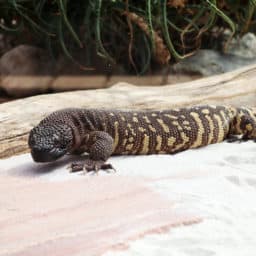
This saurian can be found in a wide range of habitats, from sea level to 1500 m altitude, living in deserts and scrubland, as well as in pine forests. Averaging between 50 and 90 cm in length, its small, round scales are very bumpy, hence the name “pearl”. It is carnivorous and its tail contains fat reserves that enable it to withstand long periods of fasting. Oviparous, it has a lifespan of around twenty years.
Heloderms are one of the few venomous lizards on our planet, along with the Komodo dragon. Its venom glands are modified salivary glands located in its lower jaw. Several compounds in its saliva are currently used in pharmacology to treat diabetes, Alzheimer’s disease and other health problems.
The greatest threat to this prehistoric species is the disruption of biotopes caused by urban development and road building, on which they are run over just like our hedgehogs.
IUCN Status : least concern (Appendix III)