- Origin: Islands of the Indonesian Archipelago: Komodo, Rinca, Padar, and a tiny part of western Flores
- Class: Reptiles
- Order: Squamates
- Suborder: Sauriens
- Family: Varanidés
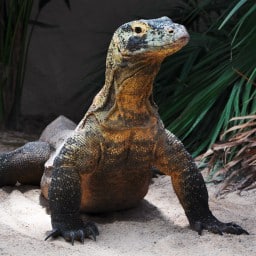
A member of the Varanidae family, the Komodo Dragon is the largest lizard on the planet, growing to over 3 metres in length and weighing more than 130 kilograms. It lives in rugged volcanic terrain with palm savannahs, grasslands and, at higher altitudes, crowns of forest.
It is a carnivore, a voracious hunter that appreciates carrion. Its jaws, armed with sixty crenellated teeth, can be opened inordinately thanks to the great flexibility of its cranial bones. It has venom glands in its lower jaw, rather than in its upper jaw as in snakes. This venom is similar to that of many snakes, but also to that of the Gila Monster (Heloderma suspectum), one of only two venomous species of lizard. The mixture of its bacteria-infected saliva and venom makes its bite deadly. This dragon has a thick armour of ossified scales and long, sharp claws, making it a fearsome predator.
Dragons mate in the wild between May and June, and the female generally lays around twenty eggs one month later. Incubation lasts seven to eight months, with hatching taking place in April when insects are abundant. Dragons reach sexual maturity between the ages of 5 and 7. The youngest dragons often take shelter in trees because of the cannibalism of their elders. They can reproduce by parthenogenesis.
Scientists wonder whether this saurian can survive today, as there are only 5,000 specimens left, scattered across a small number of islands, and their genetic diversity is decreasing, although in 1980 most of the dragon’s habitat became the Komodo National Park (KNP), a reserve that is supposed to protect them. Their range has been greatly reduced by human activities.
IUCN Status : near threatened (Appendix II)