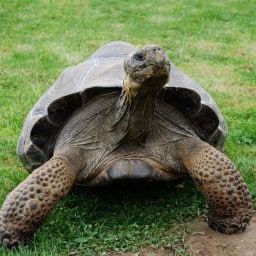
- Origin: Galapagos Archipelago
- Class: Reptiles
- Order: Chelonniens
- Suborder: Cryptodires
- Family: Chelonoidis
The Galapagos giant tortoise is the most emblematic animal of the Galapagos Islands. There are 12 subspecies, some of which can weigh more than 400 kilos and live up to 200 years.
When the Galapagos tortoise feels threatened, it can tuck its neck and head inside its carapace, which is very strong and serves as a refuge. This tortoise is exclusively herbivorous and frugivorous. Although it has no teeth, it has a sharp beak that enables it to cut the fruit and plants it chews.
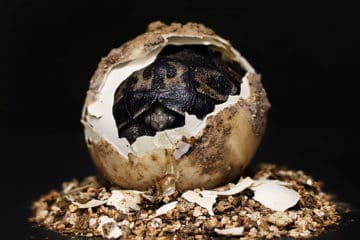
There is no particular breeding season for Galapagos tortoises. Around nine eggs are laid, and incubation generally lasts two and a half to three months, although it can last eight months if climatic conditions are unfavourable. When they are born, the future giant tortoises are tiny, weighing on average just 70 grams; to survive, they have to struggle for themselves in the wild.
Their reproduction rate is estimated at 2-3% due to their gigantic size, and only the Zoo of Zürich, Auckland and the Tropiquarium have been successful in reproducing this endangered species. Our residents reached sexual maturity in 2020 at the age of 28, with their first reproduction in 2021.
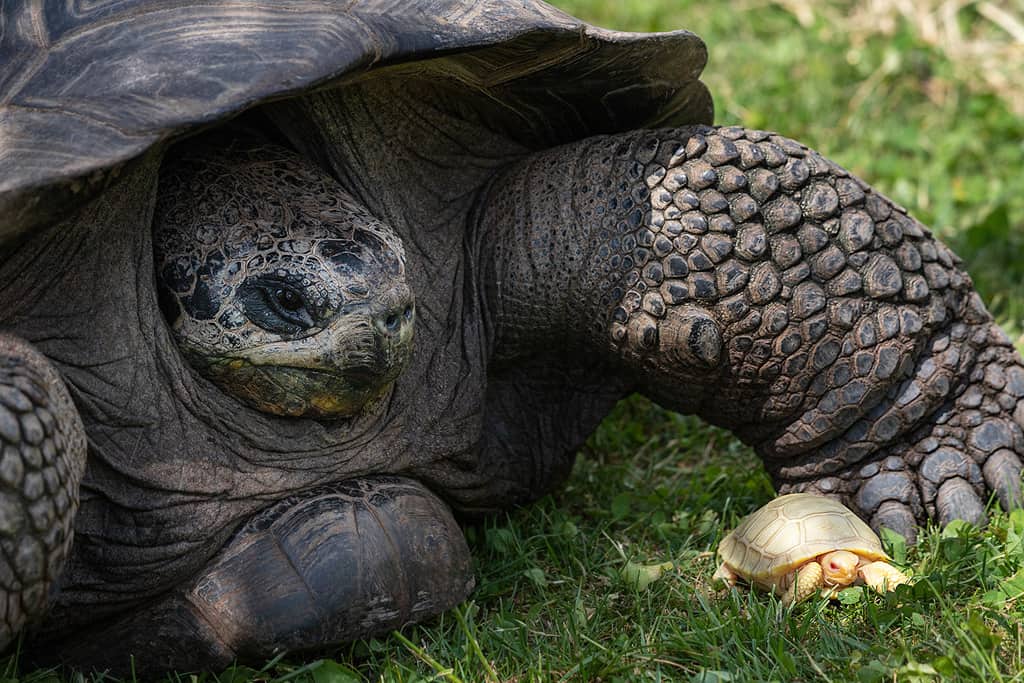
Our baby turtles are born as part of a conservation programme for the species https://www.eaza.net/conservation/programmes/eep-pages/galapagos-giant-tortoise-eep/
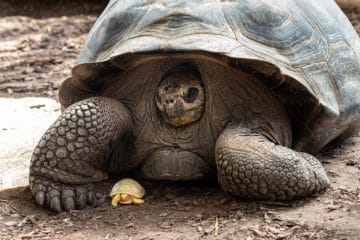
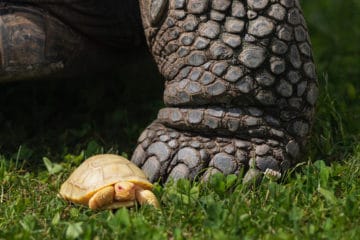
In 2022, out of a litter of five eggs placed in an incubator, two hatched: one was black like its parents and the other one was white, an albino. These are rare and exceptional births, particularly for the albino baby. Albinism is rare in turtles, with around one case in every 100,000 individuals, compared with around one case in every 20,000 individuals in humans.
This is the first time in the world that an albino Galapagos tortoise has been kept in captivity, a phenomenon that has never before been observed either in zoos or in the wild https://www.youtube.com/watch?v=qmKJ2nJ8skg

In 1535, when the Archipelago was discovered, their population was estimated at 250,000 specimens. Today, only 15,000 specimens survive. Catches by whalers and pirates in the 18th and 19th centuries decimated the species, using them as a source of fresh meat.
IUCN Status : near threatened (Appendix II)